Boat and Destination Info
About the Irish Wake
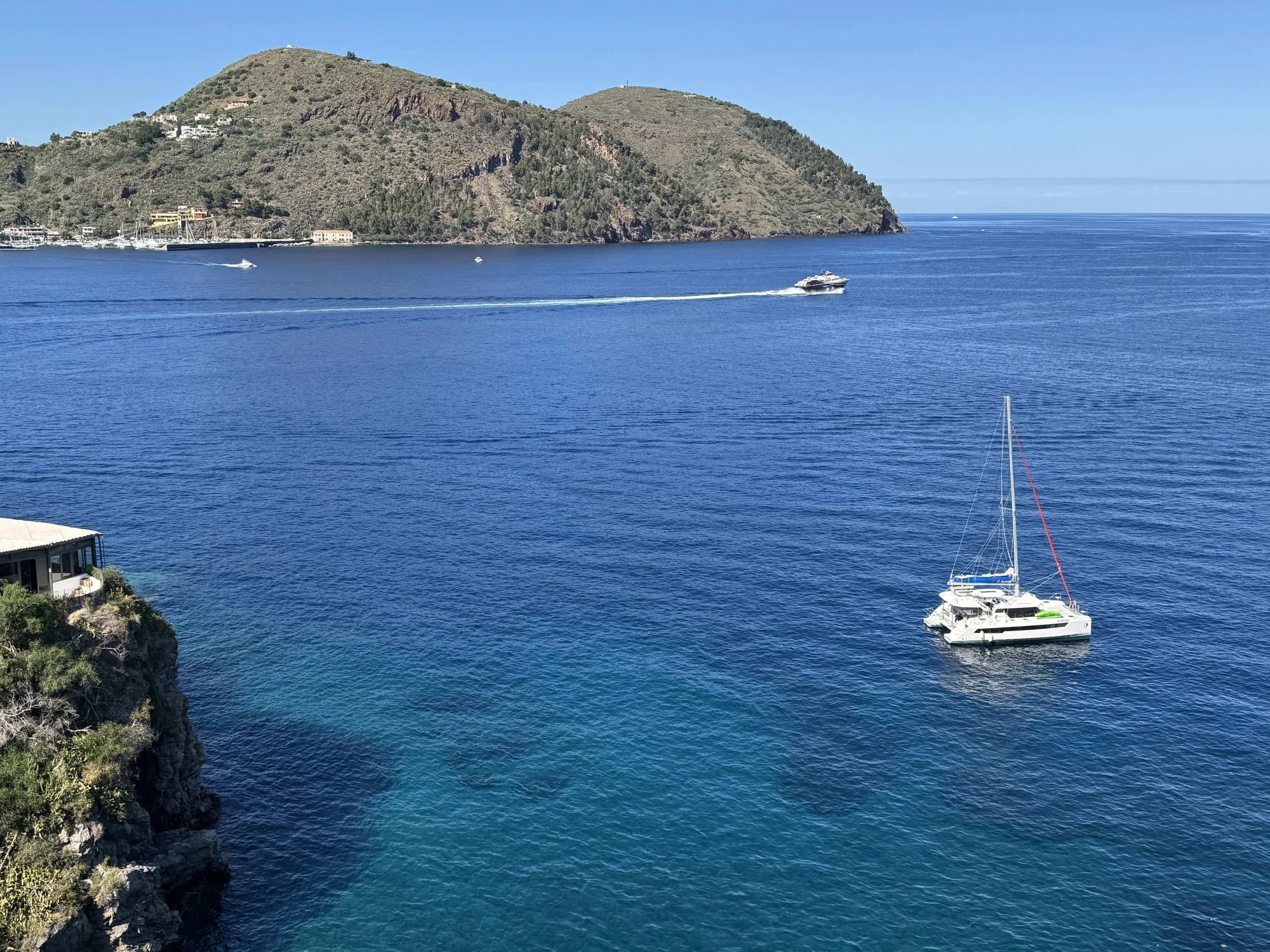
The Irish Wake is a 2026 Leopard 42-foot sailing catamaran with a 3-cabin “owner's” layout (meaning there are 2 guest double-berth cabins on port, each with a private en-suite head and shower and double bed, and one larger cabin on starboard also with a private en-suite head and shower). There are also numerous “hang-out areas” around the boat including: a huge covered aft cockpit/dining area that can easily accommodate eight for dinner; a forward partially sun-protected cockpit with beanbag chairs (Donna's favorite spot underway) leading to the trampoline and dolphin chairs; a large interior central saloon with dining area, navigation station, and full galley; and a fantastic "sun-lounge" up top that we use a lot (while sailing and for star-gazing at night). There is also a spacious raised, covered helm station that can accommodate two to three sailors. Here is a link to a 360-walk-thru, video and technical specs if you are interested.
Some great features of The Wake include the fact that each cabin has its own head (bathroom and shower) so no sharing between couples is needed. And it has an on-board fresh-water-maker (i.e. no need to worry about filling up water tanks...and therefore, unlimited showers). It also has a generator so we can run A/C and electrical appliances all night. Hot and cold running water is available throughout the ship, of course, and we have all the kitchen appliances you would expect: oven, stove, microwave, blender, toaster, coffee-maker…and four refrigerator/freezer units. The Wake has the feel of a cool Manhattan efficiency condo...that sails. BTW...it has 110V AC (American style) electrical outlets in every cabin and common space and additional USB and DC sockets throughout. To pre-empt a common question: YES, you can bring your hair dryer and curling iron! It has a great multi-zone sound system (with speakers inside and outside around the boat) that can be connected wirelessly and controlled by your iPhone....so bring a few playlists (or else you may end up hearing Cartman singing "Come Sail Away" multiple times a day on Tim's sailing playlist.) We have a ship-based WiFi system that has very good connectivity (via a cellular network) throughout most of the archipelago. (You are, of course, welcomed to log on with whatever devices you want.) We’re generally able to stream movies and such almost everywhere we moor. We also have a BBQ aft and a motorized dinghy for shore excursions (which can be lifted out of the water by a motorized davit for when we are under sail). There is an electric windlass (for lifting the anchor) and electric winches for controlling the sails. There are cool underwater blue lights that attract freaky huge fish at night. And, there is even a small shower with hot and cold water near the swim-ladder for a quick fresh-water rinse after swims.
About “The Base” in the BVIs
The Irish Wake is docked at the Moorings/Sunsail Base in Road Town, Tortola, British Virgin Islands. Tortola (with about 24,000 residents) is the largest and most populated island in the BVIs and Road Town (with only about 9500 residents) is the capital of the country. The Moorings Base is situated just to the east of the central business district (which is about a 10-15 min walk away).
The Base is located about 30 min by cab from the Terrance B. Lettsome International Airport (EIS), which is on the extreme east end of the island. A cab from the airport to the Base is typically US $16 per person. Just a short 2-minute walk from the airport arrivals hall is Trellis Bay which, in addition to having a very nice palm-lined beach and boardwalk, offers a number of casual beach-side restaurants and bars and a small shop. There is a dinghy dock at Trellis Bay and there are plenty of mooring balls for the Irish Wake out in the bay, so Trellis Bay is an ideal place for us to pick up or drop off guests who may be flying in or flying out during a longer charter. (You may see or hear the term “Beef Island”. The airport and Trellis Bay are technically on Beef Island, but Beef Island is connected to Tortola by a short bridge, so Tortola and Beef Island are effectively one land mass.)
The Base in Road Town is like a small upscale resort compound. When you arrive, there will likely be a customer representative who will meet as you step out of the car at the flowered tropical portico and guide you into the open-air atrium…often with a welcome drink. After a quick check-in, you can leave your luggage in the atrium with the staff and explore and enjoy the Base. There is a large Spa to the right with massage services that can be easily booked and a very nice air-conditioned set of shower/changing facilities you are welcomed to use if you need to freshen up. Off the atrium, there is also a clothing shop, ATM, and a coffee-shop. Passing thru a hall near the Spa and heading outside, you will see the small double-storied boutique hotel and shortly afterwards a newly-updated pool with towels, loungers, and an associated outdoor bar, all of which you are welcomed to use. There are also two restaurants (Charlie’s…which overlooks the marina and is the fine dining establishment, and a slightly more causal restaurant past the pool). Also, beyond the pool (still on the Base) is a new, full-service grocery store (which may be helpful for last minute provisioning) and another resort shop. Free Wifi is available throughout the Base (log-on details are displayed on a sign in the Atrium). There is also an on-site dive shop. The rear of the Base is where all of the Mooring and Sunsail fleet reside…it’s a pretty big and busy operation…but you are welcomed to walk around the docks and check out the boats. (Most often, the Irish Wake will be parked somewhere along Dock B.)
The area immediately outside the security perimeter of the Base is a bit industrial without too much to do….BUT…there is an AMAZING French bakery and grocery store less than a block from the front gate of the base (you’ll see it on your left as you drive in). You can load up on freshly-made French sandwiches, breads, pastries, croissants, coffees, soups, pâtés, cheeses, quiches, mustards, condiments and sauces of all sorts, and much much more. They also have a great wine section, which is not very common in the islands. We do a lot of our last-minute provisioning here for breakfast and lunch items.
Getting to Tortola
There are several options for travel to Tortola (EIS) from the US.
The newest (and possibly most convenient) option is a daily non-stop jet service on American Airlines (flown as American Eagle) from Miami. (This flight was launched as a seasonal service a couple of years ago, but now seems to be running as often as five flights a day.)
Another very common option is to fly to San Juan, Puerto Rico (SJU), a very large airport served by most major US carriers including Southwest, and then connect to a puddle-jumper prop plane over to Tortola….about a 30-40 minute flight. There are several carriers including InterCaribbean Airways and Cape Air that fly between SJU and EIS. (Puerto Rico is also a great place to visit if you have some extra time.)
Another option (not yet tried by us) is to fly to nearby St. Thomas in the US Virgin Islands. St. Thomas has a much larger airport (STT) than Tortola and many more flight options from the US mainland. From St. Thomas, (either its capital city Charlotte Amalie, near the airport, or Red Hook on the eastern end of the island), there are several ferry services to Road Town (although the reliability of these services is apparently variable). The different ferry services operate on alternating days, so you may need to check with multiple ferry line operators to find one that has crossings on the day you are travelling. Depending on the specific ferry you take, the trip can take as little as 50 minutes…we’ve heard rumors that you may spend more time in the line at BVI customs than you will on the ferry itself. From the Road Town ferry terminal/customs house, it is about a 5-10 min taxi ride to the Base.
A Typical One-Week Sailing Itinerary for the Irish Wake
Day 1: Road Town to Cooper Island
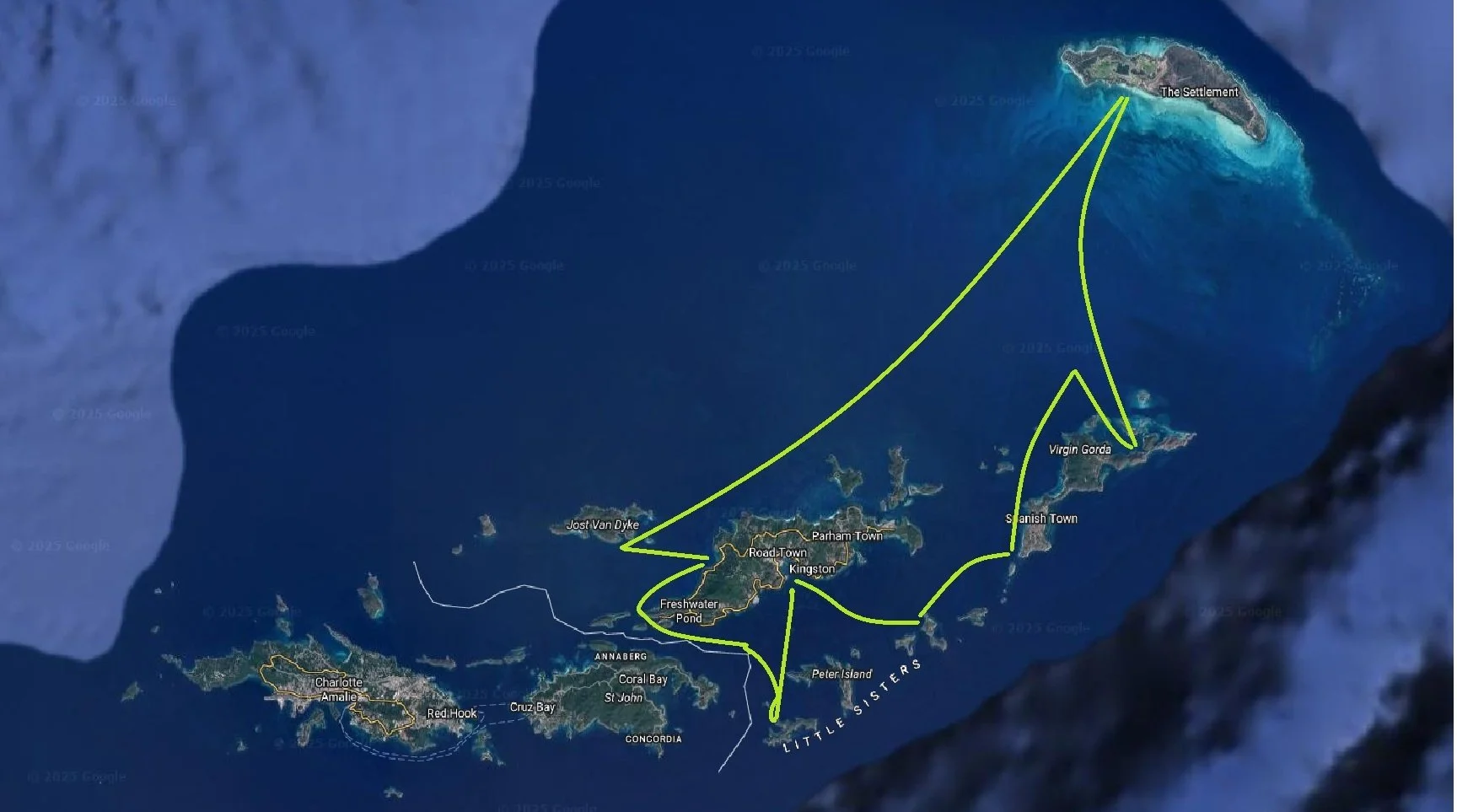
On the first day, we typically cast off from the Moorings Base in the morning and motor out into the Sir Francis Drake Channel. We find an open area and let anyone on board who is interested take the helm and get a feel for operating the boat under power. That includes forwards, backwards, spinning the boat in place, figure 8’s, etc… This is also when we do a quick safety briefing pointing out all of the safety equipment on the vessel and discussing crew overboard procedures (with a big focus on avoidance, but crew readiness if it should ever happen). We then hoist the sails and head across the channel toward Cooper Island. This first sail is a great one since we are generally headed east (which most of the time means right into the wind) so that gives us an opportunity to tack the boat and practice that important maneuver a few times with our new crew. Anyone interested is always welcomed to take the helm and/or help with the sails and/or help in any other way they want! Once we get to the bay off Cooper Island, we grab a mooring ball (it’s generally a well-protected bay and a good place for a new crew to practice mooring procedures). As soon as we moor up, the pool is open! Cooper is a great place to swim and snorkel. There is a small rocky island at the end of the bay with tons of fish. The main part of the bay is grassy and the home to a lot of sea turtles. After swimming and snorkeling, we usually freshen up, have a cocktail and hors d’oeuvres, and then dinghy over to the island itself. There is a beautiful, very small resort there with a fantastic open-air restaurant, a great little beach, and a fantastic palm-lined boardwalk to the best rum bar in the Caribbean. Sunsets at Cooper range from amazing to absolutely AWESOME (like some of the best in your life!) with the sun setting between palm trees and flowers framing Tortola off in the distance.
Day 2: Virgin Gorda, The Baths, Leverick Bay, Saba Rock, Bitter End Yacht Club
This is a BIG day. We try to get underway as early as the crew is willing, eating breakfast while en-route to the Baths at the southern tip of Virgin Gorda. (Folks can, of course, sleep in if they want as we make our way to Virgin Gorda.) The Baths are an unforgettable maze of boulders and rocks right on the beach that form huge cathedral-like rooms filled with knee-high sparkling water and beams of light punching in from various angles creating a stained glass effect. The Baths look like some giants were playing with enormous boulders on a beach and just left them stacked in the most precarious positions. Since the Baths are the most popular tourist destination in the BVIs, we try to get there as early as possible (before the cruise ship excursions flood the area with tourists). When we get there early, we usually have the entire place to ourselves. We moor the Wake and then take the dinghy to a dinghy line. Dinghies are not allowed on the beach at the Baths, so we all have to make a swim for it to the beach. (There is a floating line that leads to the beach, so it’s easy to hold on for a break or go hand-over-hand if you want.) Once on the beach (which is STUNNING, BTW), we explore the Baths and do a bit of hiking (there are great views from the hills above the Baths). After the Baths, we set sail north along the west coast of Virgin Gorda (passing Spanish Town…and possibly stopping to visit Spanish Town if folks are interested.) We continue northward well past the northern tip of Virgin Gorda, then tack around to the south to enter beautiful Leverick Bay (buzzing by Necker Island, Sir Richard Branson’s private swanky island and menagerie of exotic animals. As they always say, a billionaire with his own private island in the Virgin Islands….what could go wrong?) On the northeast side of Leverick Bay there are two iconic places. First is Saba Rock, a very small island resort with an elegant restaurant, a great bar with swings, a tiny hotel, a one-hole golf course, and a classic British phone booth. (We’ll probably hike around the entire island…don’t worry, it’ll only take 2 minutes max.) And second is the famous Bitter End Yacht Club about a quarter-mile away, with a slightly more causal vibe (and the first, and we still think, the best wood-fired pizza oven in the country). We usually moor near Saba Rock and dinghy into both locations to check them out, have a drink at each, and have dinner at whichever restaurant folks prefer. In the mooring field, there is usually a Canadian kid with a frozen drink machine on his boat, the Rum Runner. If you hit him up on VHF 72, he’ll come flying over with his dog and with really delicious frozen daiquiris. What service and what a life!
Day 3: Anegada
Another BIG day of sailing. After wrapping up our exploration of Leverick Bay (possibly visiting the Leverick Bay Resort and Marina and/or Oil Nut Bay—one of the newest and fanciest resorts in the country) we head due north out of Leverick Bay toward Anegada, the second-largest island in the country. (We’ll only head to Anegada if the conditions are optimal. Since it’s an open water passage exposed to the Atlantic swell, it can sometimes get a little rough out there with some broadside waves.) Anegada is the only non-mountainous island in the BVIs and it is the farthest removed from the rest of the archipelago…about 12 nm from Leverick Bay. Since it is so low-lying, it will seem like we are headed off into an adventure on the open ocean…Anegada doesn’t become visible until we are about half-way there. Once we get to Anegada around lunch time, we will navigate a tricky shallow entry into a fairly small (and also very shallow) bay off “Setting Point”…one of the two little towns on the island (there are only about 450 residents of the island total). Anegada is famous for its lobster. So, we’ll stop at one of the two or three bayside restaurants to put in our order for dinner…the dudes there will catch however many lobsters we order. If folks want, we can then rent either some motor scooters or some beat-up little buggies from the very grumpy lady and explore the island. There is a large pond in the center of Anegada where pink flamingos hang out. If we are lucky, we might spot them from the flamingo observatory along the road. We can also then head to the north side of the island (which is essentially one long beach) to visit one of two cool spots…Loblolly Bay or Cow Wreak Beach. Each has a bar, small restaurant, friendly people, and changing facilities, etc…and, of course, a great beach. After hanging out on the beach, we can drive back to the boat, and get ready for a great lobster dinner at whatever restaurant we previously picked.
Day 4: Jost Van Dyke, Sandy Spit, Bubbly Pool, White Bay Beach, Great Harbour
The BIGGEST DAY OF SAILING. If Neptune is smiling (let’s not forget to pour him a little shot of rum before leaving!), we should have a fantastic downwind sail from either Anegada or Leverick Bay on a b-line all the way to Jost Van Dyke (about 27 nm away from Anegada) with Tortola and many other islands visible in the distance the whole way down. As we get close to JVD, we’ll probably stop near the Sandy Spit and dinghy over. The Sandy Spit is a cool little white-sand castaway island (about the size of a baseball infield) with a small stand of palm trees in the center. It’s a great place for a little swim and soak…and a fantastic place for a Tom-Hanks-and-Wilson-type photo shoot. Not too far from the Sandy Spit on JVD itself is the Bubbly Pool…a place where Atlantic swell crashes into rocks on the north side of JVD filling a small swimming hole with warm bubbly water. It’s a fun little place about a half-mile hike from a dinghy dock on the east side of JVD passing by a few poisonous manchineel trees, which are usually pretty well marked. From there, we’ll head down to White Bay Beach (Tim’s favorite beach in the entire world). The beach, as advertised, is gleaming white with soft squishy sand surrounded by palm trees and mountains and views of Tortola and St. Thomas, USVI in the distance. There are several bars and restaurants there including the world famous Soggy Dollar serving the BVI’s national drink, the Painkiller. (The Sog got its name from sailors anchored off the beach who swim in with their….soggy dollars.) If you want to get in the BVI mood before or after a trip to the BVIs, you can always tune your phone, computer, or Alexa-enabled device to “Soggy Dollar Radio”…they broadcast and live-stream all the music they play in the bar and you can pick them up on apps like “Radio Garden”—lots of Bob Marley but plenty of other cool tunes too. After a Painkiller or two at the Sog or Hendo’s next-door, we’ll sail around the corner to pick up an over-night mooring ball at Great Harbour. Great Harbour, the “capital” of JVD has a famous seafood-oriented beachside restaurant called Foxy’s…where we will likely get dinner. It also has the biggest Halloween party in the Caribbean…so be warned!
Day 5: Cane Garden Bay
Cane Garden Bay is just a short crossing from JVD back to the mainland of Tortola (on the opposite side of Tortola from Road Town). There is a row of restaurants, bars and hotels on a pretty beach (that has a lot of sea turtles). On the far end of the beach is the only remaining rum distillery in the BVIs…a very rustic family-owned business that offers short tours and a rum tasting at the end….a fun experience. This can be a low-key relaxing beach day…or for more adventurous folks, Sage Mountain, the tallest point in the BVIs is nearby and a hike there can be arranged for you mountain-climbing animals.
Day 6: Soper’s Hole, the Indians, Norman Island, Willy-T’s
Heading out from Cane Garden, we’ll sail around the southwest corner of Tortola, perhaps stopping at Soper’s Hole, a deep-water, modern marina with a huge (by Caribbean standards) double-decker grocery store, nice shops, and, sometimes, some of the largest super-yachts in the world. (The last time we were there, Zuck’s monstrosity of a yacht…the sixth largest in the world…was hogging up basically the entire port. Naturally it had two helicopters up top…you know, just in case.) As we come around the corner we’ll be entering a narrow channel (called, appropriately, “the Narrows”) with the wind on our nose (and St. John Island in the USVI almost touching-distance to our starboard). We’ll likely douse our sails, flip on the engines, and rock and roll thru this stretch (which can get kind of exciting-rough as the entire Caribbean Sea tries to squeeze through this opening to the Atlantic). Once through (about 20 min), we’ll zig-zag upwind to the Indians, a cool set of rocks jutting out of the sea with AMAZING snorkeling. On the east side of the rocks, there is a fairly shallow and fairly protected area (ranging from about 5 to 20 feet deep) teaming with fish and some cool underwater swim-thru coral arches. On the western side of the rocks, there is a wall that drops straight down…WAY DOWN! There are some short-stay mooring balls around the Indians where we can park the Wake while we snorkel. From the Indians, it is just a few minutes to The Bight on Norman Island where we can moor for the night. The Bight is a deep and very well-protected bay. Around the corner from the entry to the Bight, there are a number of sea caves that can be entered by kayak or explored while snorkeling from the dinghy. Norman Island is supposedly the inspiration of Robert Louis Stevenson’s Treasure Island…and these caves figure into the pirate lore of the area. At the back end of the Bight is a newly-rebuilt and very nice open-air restaurant on a small manicured beach with plenty of free umbrellas and lounge chairs and calm, crystal-clear water. But the most memorable feature of the Bight is Willy-T’s, a beat-up not-so-manicured ship that is permanently anchored in the south end of the Bight and has been converted into a bar and very casual restaurant. Upstairs (pretty high up, by the way), there is a little ledge with a “no-jumping” sign from which EVERYBODY, obviously, jumps…with less and less bathing attire as the sun goes down.
Day 7: Back to Road Town
Sadly, we will be raising the sails for the last time as we cross the Drake Channel back toward Road Town (maybe after buzzing past Peter Island, whose eponymous resort just re-opened in 2025 after more than a decade following total destruction from Hurricane Irma). The developers have sunk millions and millions into the resort on this private island and it is now opened with a new marina designed to attract super-yachts as well as casual sailors like us. They have a day-pass program, mooring balls, good food, and a pool with a killer view. Back at Tortola, we’ll skim by any cruise ships docked at the terminal and swing back into a slip at the Moorings Base….with the greatest of ease…or with complete terror in a cross-wind.
NOTE
This itinerary is just a general guide to some BVI highlights. There are tons of other islands, beaches, and restaurants around the country (like Marina Cay, Scrub Island, Guana Island, Trellis Bay, Fallen Jerusalem, the Dogs, the Camanoe’s, Sandy Cay, etc…) that we can visit based on the weather, crew member preference, and the amount of time available.