
Crew Resources
Safety First! Please Review Our Safety Briefing!
Learn it! Live It! Print It!
Suggestions for Packing
The BVIs are very causal. Long pants are really not needed anywhere (unless you like sweating). In the Med, restaurants are usually just a little more dressy and it is sometimes a little cooler. Here are some suggestions.
Highly Recommended
T-shirts/shorts/swimsuits (for days)
Most guys wear collared shirts and shorts (maybe long pants in the Med) in the evenings at most of the restaurants we are likely to visit
Most women wear casual/comfortable resort attire in the evenings at most of the restaurants we are likely to visit
Sandals
****CRITICAL**** Anti-seasickness meds. If you have ANY inkling that you could possibly get seasick (or if you are unsure), please bring appropriate meds (preferably under consultation with your MD). Donna has used the scopolamine "TransDerm Scop" patch (prescription only) with a lot of success. Other folks swear by Bonine tabs (OTC). But talk to your MD. It's best to start taking something many hours BEFORE you get on the boat.
Face mask and snorkel (and maybe a little bit of mask defogger). (The Moorings provides fins.)
Lots of marine-safe sunscreen
Light-weight raincoat
Lots of quart-sized and gallon-sized zip-lock bags
Shampoo and conditioner (the Moorings provides little soap bars but no shampoo)
Waterproof shoulder-pack-sized dry-bag (highly recommended…EVERYTHING gets wet in the dinghy)
Lots of cash in small local denominations. (The BVIs are on the US Dollar as their official currency, BTW.) Throughout the Caribbean, folks will show up in their boats to sell ice (which is key!), take away trash, collect money for mooring fees, sell fresh empanadas, etc… And none of these folks takes a credit card or, apparently, can make change. Even in the Med, some mooring ball owners will only take cash.
A light-weight LED headlamp per couple (it gets pitch dark at sea…you will never see more stars!) Lights are critical for walking on dinghy docks at night, driving the dinghy back from restaurants at night, and making ourselves visible to other boaters.
Optional
Large insulated water bottle (for shore excursions)
Swim shoes (we’ll be going from ocean, to beach, to dock, to rock, to gravel, to asphalt and back frequently, especially in the BVIs/USVIs)
Sunglass lanyards
A hat with a chin strap (it can get really gusty out there and we have had lots of crew who have lost hats)
Your favorite game. Look out! Trivia night gets super competitive on The Wake! (Donna and Tim will usually bring some kind of trivia game.) We’ve had some crewmates bring dominoes, which are really good on sailboats since the pieces don’t blow away…and your Admiral and Skipper are both terrible at dominoes (although, be careful! We are getting a lot better.)
An extra towel or two. (The Moorings provides 1 bath towel, 1 beach towel, and a couple hand towels and face-clothes per guest for the whole week. You might be able to "borrow" an extra towel or two from the Base if you're sneaky or tip the maid.)
A few bungee cords. (There is always something that needs to be secured.)
A few zip-ties. (For the same reason.)
A very small bottle/tube of bug repellent. (We’ve never seen a mosquito in the BVIs or USVIs, but there are sometimes some “no-see-um” ankle-biters mostly on Jost Van Dyke. Just a dab of repellent on the ankles seems to help a lot.)
Extra (large size) garbage bags (just to keep things dry in the dinghy, etc... And for garbage. In the Caribbean, folks charge a fixed fee for garbage removal by the bag...so big black ones are a much better deal than the little kitchen ones since they often cost the same to have removed. If each couple brings 5-6 large black bags, we should be good.)
Sailing gloves (if you are planning to help with sailing. Weight-lifting gloves are perfect for this purpose.)
A “Scrubba” wash bag and some detergent sheets. We have used this to live on the road (in hotels) in Europe for weeks at a time and it works especially well on boats to decrease the amount of clothing you need to lug around. The big advantage on a boat: drying. The Wake is surrounded by safety lines that make excellent (and, because of all the sun and wind—FAST) clothes-drying lines…and the Moorings provides clothespins. At an anchorage, you can tell who the real sailors are by the number of unmentionables they have flying on their safety lines! Remember, sailors have no shame.
Suction cup hooks and line. (There are no hooks in the heads for drying wet things and the towel racks are very small. We find that a cheap pack of suction hooks and a little line are great for impromtu interior clothes drying, if it is rainy.)
A drone. (It would be super cool if you have one and you’re confident in your flying skills over water and around the standing rigging of a sailboat!)
To Avoid
“Waterproof” smartphone holders. (Be careful with these! We had one crewmate who brought such a holder, but it leaked and destroyed his brand-new phone anyway on the first swim…so be sure to test it out with paper towels in your sink at home.) Alternatively, and MUCH safer, keep your phone inside a zip-locked bag and put the zip-lock inside a dry-bag while on the dinghy or near the water.
Note
If you are bringing two suitcases as a couple, it would be great if one of them could be nested inside the other for storage during the week. (We’ve got a fair amount of room for suitcase storage in enclosed lockers, but not a TON of extra room, especially if all the cabins are occupied.) If you have soft-side collapsible suitcases, even better! (Don’t worry about this too much, we’ll find room to hide away all suitcases and make everything fit.)
Apps
These are some dedicated apps that your skipper will have. But redundancy is always a good idea. And downloading these in advance and playing with them during some boring Zoom office meeting will help get you in a sailing frame of mind!
“i-Boating: Marine Charts & GPS”. (A great app for marine charts and weather and a good back-up for the ChartPlotter if it were to fail. The electronic maps are fairly expensive…about $25 for the BVIs.)
An anchor alarm app. (These GPS-based apps ring an alarm if the boat swings beyond an expected area. They’re great to alert us if the boat starts to drag during the middle of the night or if the mooring line fails.) There are a million such apps. For the BVIs, “Boaty Alarm” (built by the same people who created Boaty Ball) is especially good because it has the exact GPS coordinates of all the mooring balls in the country already programmed in, which really increases accuracy.)
“Predict Wind” (The #1 weather app for serious sailors. It includes wind, tides, wave heights, currents, etc… We rely on it to plan sailing passages.)
“Fusion-Link”. This is an iPhone app that can control all the speakers and zones of the sound system on the boat via Bluetooth. And it allows you to pump in your favorite playlists to whatever corners or areas of the boat you want. We highly recommend that you download it….it’s free!
You’ll want to bring a few music playlists too!
Knots
There are just 4 that you need to know!
“I didn’t think you were serious about how important the knots are. If I had known, I would have learned them ahead of time! Knowing them makes everything so much easier.”
—Exact unsolicited testimonial from a previous crewmate
Please be the first crewmember in history to have these knots learned BEFORE you get on board! Be ready to tie them while standing on your head, upside-down, and singing Skip-to-Ma-Looo! (Since we know you’re not going to do that…please at least take a peak at them and pretend that you’ve practiced.)
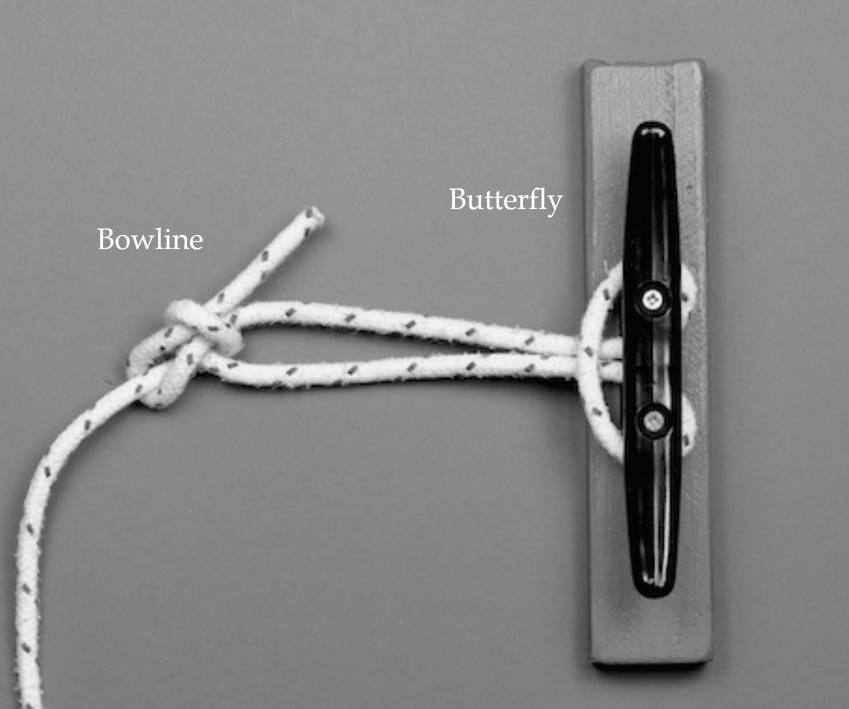
Bowline. The bowline (“BOW-lin”…as in “Bow” and Arrow and “Lynn”) creates a loop, usually at the end of a line, that won’t slip or slide. It’s quick to tie. It is very easy to untie (which is even more important), and we use it several times a day to secure the boat to a mooring ball, for example. Once you know it, you’ll be using it all the time back home. Bowline Video The loop of a bowline can be “butterflied” through a cleat to make a really secure attachment…that is the way we’ll often be using it. (See the photo below. This line’s going nowhere.)
Clove Hitch. This seems like a super whimpy knot….and it kinda is…and the guy in the video REALLY is. But it is the PERFECT knot for securing and adjusting fenders (you know, the things land-lubbers always call “bumpers” that prevent us from scratching up the sides of our boat and other boats). We’ll drop the fenders down the sides of the boat and tie them to the safety lines that surround the boat using a clove hitch. (We have to do this A LOT, especially when we are coming into a marina). The clove hitch is really fast to tie. It is really easy to untie. And it is really easy to adjust right before we slam into a Russian oligarch’s superyacht. Clove Hitch Video
Cleat Hitch. This is probably the trickiest. We use it to secure lines to a cleat (we have 10 cleats on the boat and we’ll find cleats on docks everywhere we go). We’ll be using this knot many times a day (often on top of a butterflied bowline on the same cleat) to tie up to a mooring ball, or tie up the dinghy, usually with some time pressure and urgency….OKAY, A LOT of time pressure and urgency. The last part of the Cleat Hitch, that final twist, is “the lock” which locks the knot. Almost everybody gets it wrong at first. If you have any doubt about how to tie a cleat hitch…no problem, you can use the cheater OOXXOO method to get the boat secured quickly. The cheater OOXXOO method means two wraps around the base of the cleat, two crosses over the horns of the cleat, then two more wraps around the base. That’ll get us temporarily secured…and give us plenty of time to come back later and put in a “proper” cleat hitch at our leisure (from a crew member who actually learned the cleat hitch). Cleat Hitch Video Cheater OXXO Hitch Video Unlike the video, we recommend adding one extra O at the beginning and one more O at the end…we’ve got a much bigger boat and therefore a lot more pressures on the lines…but you’ll get the point from the video. So, remember OOXXOO!
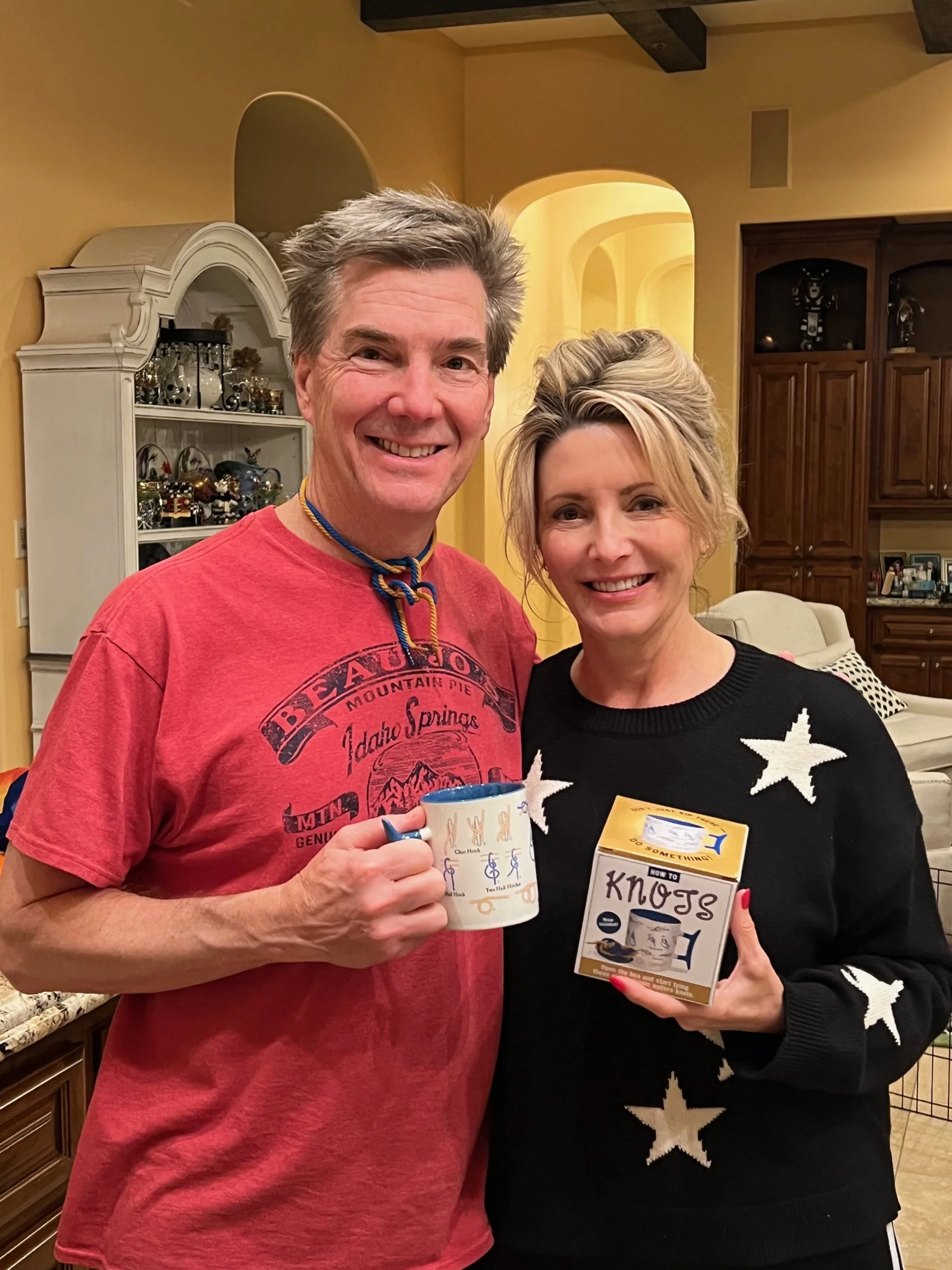
The Dena Dangle. This knot is used to garrot your significant other who is trying to teach you about knots. See Mike below demonstrating a smartly placed Dena Dangle…fashioned by Dena herself. (If you can garrot your significant other on the first try…then CONGRATULATIONS! You’re already way ahead and have just THREE more knots to learn!)
A Typical Day
A typical day for us usually starts the night before when we gather to have a crew meeting after dinner. (It’s VERY casual, usually with a beer, wine, or cocktail in hand.) If anybody has some good (or embarrassing) pictures from the day, we’ll probably cast them up onto the TV. Then we’ll do the traditional airing of grievances. (No…of course not! Just kidding! Obviously, no one has ever had a grievance on one of our trips!!) But we probably will rib each other a little bit. And then we’ll chat about what we want to do the next day and when we want to get going. There is often a nice sailing guidebook with a lot of color pix in the nav station to help. We’ll generally cast the weather and a chart up onto the TV and pick a destination or two (maybe a town if folks want to go shopping or eating out, maybe a beautiful beach on an uninhabited island, maybe a national park with great snorkeling, or maybe some other famous nearby landmark). We’ll figure out how much sailing (or in some cases, depending on the wind and weather, how much motoring) it will take. Then we may head upstairs to watch the stars from the sun lounge, or play a rousing board game or trivia game, or play some music, and at some point head off to bed. (If we are moored or anchored, anyone and everyone who has an anchor alarm app on their phone can set it, just in case we might start to drag in the night (redundancy is good!)…it’ll give us some warning to make sure we are secured and start the engines if we need to.)
(Note, we won’t be sailing at night. And the amount of sailing we do on many days may be less than you would expect…maybe just 1-4 hours or so, depending on how much folks want to sail and where folks want to go. If we find an exceptionally cool place, and folks want to spend a full day there relaxing, we might not even sail at all…if that is the consensus of the group.)
Your skipper is often the first up in the morning and will likely get the first pot of coffee going. Most often, we eat breakfast on board…cooking up whatever folks have previously discussed as their preference for breakfasts…on some trips that has meant full cooked breakfasts (like pancakes, eggs, omelets, scrambles, etc…) or on other trips lighter fare (like fresh fruit, yogurt, cereal, pastries we picked up at a place the day before, etc…). Occasionally, we may be parked at a dock in a little town or village, in which case, some folks might want to walk over to a cafe or little restaurant for breakfast…totally up to you.
Once folks are done eating, we can either stay for a little bit so folks can swim, snorkel, etc… or go for a drive on the dingy (or maybe paddleboard or kayak, if we have previously rented that equipment), or we can get going to the next destination. (Anyone who wants to sleep in while we are underway is certainly welcomed to do so.)
Just before we leave, the skipper and any interested crew will do a complete walk-around inspection of the ship looking for any open hatches, unsecured items, etc… And we’ll also check to make sure that the swim ladder is up, the dinghy is up and secure, the safety lines are all clipped shut, etc… Then we’ll fire up the engines and cast off. We’ll typically head out to an open area, point the boat into the wind, and then raise the mainsail (which is best done with two people working together). We’ll then get on course and deploy the genoa (the big sail out in front), kill the engines and sail away.
All crew are, of course, welcomed to take the helm, plot the course, participate in trimming (i.e. adjusting) the sails, etc… In terms of navigation, the ship has the latest equipment which includes a chart-plotter (basically, an advanced GPS system for maritime vessels), AIS (Automatic Identification System, which is integrated into the chart-plotter and is a sophisticated anti-collision system that calculates the time to and closet point of approximation to any other AIS-equipped vessel), wind instruments (also integrated into the chart-plotter), auto-pilot (integrated into the chart-plotter), depth indicator, VHF, forward facing camera, etc… (It all sounds trickier than it actually is.) Even if you are new to sailing, if you are interested, you’ll likely be in command of the vessel, to the extent that you are comfortable, within a day or two. The skipper will always be nearby to help. You’ll have as much time at the helm as you want.
Amazingly, not everyone will want to sail the boat! (Hard to believe, I know!) If you prefer, you can spend some or all of the day’s sailing up on the foredeck (which is a great place to feel the wind, hang out on a beanbag chair usually chatting with others, watch for dolphins, etc…). Or you can hang out in the sun-protected aft cockpit reading a book. Some may prefer to hang out in the sun-lounge up top…it gets pretty sunny up there watching the islands drift by! We may make lunch on-board while underway (often sandwiches and/or salads), or we might stop at a restaurant somewhere along the way.
We’ll then “park” the boat at our destination….more about parking later. Once the boat is secure, the pool is open and you are welcome to drop the swim ladder and jump in for a snorkel or swim. Some or all of us may then swim or dinghy to shore to explore a beach, or a town, or a resort, or a winery, or some other landmark.
By a least an hour or so before sunset, we’ll probably all be back on the boat to shower and change and freshen up for dinner. We’ll probably have some hors d’oeuvres and maybe a glass of wine or something. Depending on crew preference, we may then dinghy over to a nearby restaurant (which seems to be the primary preference for most of our crews we’ve had). Or, if folks are interested (or if we’re in a remote area far off the grid), we might cook dinner on board. If there are lobster to be had, we might grill some up on the BBQ. (We’ll discuss food preferences with the crew long before we start the trip and have a general dinner plan for most nights.) If we are returning from a restaurant at night, we’ll be sure to bring some flashlights in the dingy to help navigate back to the boat.
After dinner, we’ll decompress a bit. Have a quick crew meeting to discuss plans for the next day…and REPEAT! What a rough life!
Food, Glorious Food
A month or so before the trip, we’ll have a Zoom call which is usually about 95% focused on FOOD. We’ll try to get an idea of what kinds of things folks like to eat, anything they hate, and any restrictions, special diets, or other preferences. We’ll likely be eating most breakfasts and lunches on board (since there are usually not a lot of breakfast and lunch places around on the high seas), so we usually start there. On some of our trips, folks have really wanted to do fully cooked breakfasts (omelets, bacon, eggs, pancakes, etc…) with fruit and yogurt, etc… (All that is easily done since we have a full galley.) On other trips, folks have said that they just want a little cereal. (We’ll be flexible and arrange whatever the group wants.) When we’re sailing, we try to keep lunch a bit simple (with things like salads, sandwiches and soups), but sometimes we’ve pulled over on the side of the road and cooked up burgers and fries, etc… The big question is dinners. On most of our trips, folks have wanted to eat out at fun restaurants (and that is usually what we do). In the BVIs, we’ve hit pretty much every restaurant…and have a lot of favorites we’re hoping to share with you! In the Med, the food is typically crazy good! But on one trip, we had a group that REALLY wanted to cook most dinners on board (on the BBQ, for example). That, too, is possible. On all of our trips, folks have liked having some hors d’oeurvey things (cheese, crackers, nuts, grapes, etc…) and other snacks and we’ve always gotten a big basket of fruit which seems to be well-liked (or at least well-eaten).
Once we get an idea of everyone’s preferences, your skipper will start preparing a provisioning order. (In the BVIs and most Moorings locations, we can order provisions on-line in advance, and everything will be loaded onto the boat for us before we arrive.) We’ll usually circulate the order for everyone’s review before placing it. (Prepare for a little sticker shock…everything is expensive in the BVIs and the Caribbean in general. Food in the Med is a little closer to US prices.)
We’ll also typically do a last-minute provisioning run on the morning before we cast off. In the BVIs, that usually entails a trip to a great French supermarket about a half block away for pastries, croissants, breads, sandwiches, soups, etc… In other locations, there is usually some sort of store within walking distance.
Parking the Boat
Everybody thinks sailing requires so much art and skill and the people who do it are so cool (and good looking)! (Let’s not disabuse them of these ideas!) But sailing is, frankly, EASY. It’s parking the darn boat that’s the tricky part!
There are generally three options for how we secure the boat each night: picking up a mooring ball, anchoring, or tying up on a dock.
Picking up a Mooring Ball
Picking up a mooring ball is what we do most often because: it’s pretty easy; it’s generally pretty secure; it’s not too expensive; and it usually gives us very good dinghy access to locations on land that we want to visit. There are two “flavors” to mooring balls…self-serve and assisted.
In the BVIs, they have a fantastic self-service system (and app) called “Boaty Ball”. Most of the mooring balls in the country are on this system. Boaty Ball balls are generally well-inspected and well-maintained and you can reserve balls in advance (and pay for them) starting at 7 am each morning on the app. (Your skipper will likely be waking up each morning at 6:57 am to logon and make sure we get a good ball at exactly 7 am….popular mooring fields in high-season in the BVIs can sell out in seconds!) There are also non-reservable balls called FCFS (First Come First Served) that we can grab in person starting at noon local time. Either way, once we get to a mooring field, we’ll find our ball, then we will line up the boat (while motoring) so that we are approaching it from down-wind. As we get close to the ball, the skipper won’t be able to see it, so we will be dependent on the crew with a headset walkie-talkie to guide him in. (Your Skipper and Admiral generally travel with walkie-talkie headsets for this exact purpose. We’ll have some back up hand signals figured out, just in case.) In the BVIs, each ball will have a long floating line (called a “pendant”) attached to it with a ring at the end. We’ll need to pick up the pendant with a boathook from the bow of the boat, then run two prepared mooring lines through the ring, then secure those lines to our bow cleats. It can be a little tricky, especially if it is windy and the boat is being blown around. But we’ll get it. We do have to be very careful that the mooring lines run from the cleat, directly out to the ball and back to the cleat, without crossing on top of the ship’s safety lines or other gear on the front of the boat…the mooring lines can destroy equipment on the bow if incorrectly tied! FCFS balls are usually $40 per night and reservable Boaty Balls are $55 per night.
Assisted balls are, counter-intuitively, a little more of a pain. (You find these in the Med and southern Caribbean.) Basically, the balls don’t have a pendant, so you are more or less reliant on someone in a small boat (usually the owner of the ball, but sometimes just a rando looking for a tip) to come up and park their little boat next to the ball. Once we are close, the crew lowers our mooring lines down to the guy (it’s always a guy) while the skipper tries not to run him over. The guy in the boat threads the lines through a ring on top of the ball, and then hands the lines back up to the crew on the bow. The crew then ties the lines off on the bow cleats…and the guy then collects a fee or a tip. In the Med, we’ll call ball owners on WhatsApp or VHF in advance to find out if they have a ball available and what the price is, and then they will send a boat once we call them to let them know we have arrived. In the Southern Caribbean, randos will just come out to our boat whenever we get anywhere near a mooring field and show us where they think we should go. It is impossible to be sure what the relationship between the rando and the ball owner is…and there may be multiple randos fighting with each other to get us to follow them, and a lot of dickering and nonsense about the price of ball, how much tip they should get, etc… (Balls in the BVIs are SO MUCH EASIER!) Occasionally, we’ll find a ball with no randos around. In which case, we’ll have to launch the dinghy, have someone in our crew drive around to the ball, catch the lines, thread the ring, and hand up the lines. It’s a big pain! Balls in the Med can be pretty expensive, up to 80-100 Euros per night. Balls in the southern Caribbean are more like US $30-40 per night plus the tip for the rando. Even if we have to tie up ourselves, someone for sure will come around later to collect a fee. (Always try to get them to give you a receipt. Not all of the guys collecting fees are the legit ball owners or their representatives! If the guy doesn’t have a receipt to give, he might be a real RANDO rando (i.e. scam artist), just trying to get some free money.)
Once we’re securely on the ball, someone from the crew (usually the skipper) will have to put on some fins, jump in, and swim the line (inspecting the line that connects the ball to the sea floor and assuring that it’s in good shape). There are a ton of idiots out there…and some of them may have chewed up the line with their propellers. We don’t want to be connected to a ball that is hanging on by a thread! (We had a mooring ball break off on us for that exact reason….we were super lucky because the ball broke off almost immediately, before we had even shut down our engines. Many other sailors are not so fortunate…a poorly maintained ball is a great way to end up on the beach or rocks! (If you want to see what I’m talking about, watch this super sad video of BVI boating celebrity, Alan, from the Wandering Hillbilly YouTube Channel, and his horrible experience about two years ago in his brand-new power cat, which was utterly totaled. It’ll make you want to cry. Don’t worry though, Alan is just about to board his NEW brand-new power cat in Miami before a permanent relocation down to the BVIs as of this writing—Jan 2026. This is a real cautionary tale.)
(Boaty Ball balls tend to be very good in this regard. The first 15-20 feet of the line is generally made out of thick chain….so the likelihood that it has been chewed up by a prop is very low. Other mooring ball lines can be a lot more sketchy.)
As your skipper often says, you don’t want to be around sketchy balls.
Anchoring
In principle, this sounds like a great way to go because it’s generally free. In practice, there are fewer and fewer spots to anchor near places where we will want to visit on a vacation (near desirable towns, restaurants, and beaches) because a lot of the best places are today filled with permanent mooring ball fields. Anchoring also has its own tricks and challenges. Books have been written about anchoring, so we won’t get into all the details here, but in general, we will want to anchor in a sandy spot that is protected from sea swell and waves and is not too deep. (Those criteria right there significantly limit our options.) And we will want to be anchored a good distance from other boats so we don’t swing and hit them in the middle of the night…that REALLY drops the options since any good sandy protected spot will probably already have a ton of boats anchored there. If we do anchor, it’ll likely be at a pretty remote location.
The drill for anchoring sounds pretty simple. We have an electric windlass (that raises and lowers our anchor and anchor chain down to the bottom). Once we get the anchor where we think we want it, we’ll continue to lay out a lot of chain on the sea floor while slowly inching backwards (so that the anchor has a better chance of digging in and setting). How much chain??? Again, books have been written about this…..but in general, more is always better in terms of setting the anchor. The problem is the more anchor chain we put out, the bigger our swing, meaning we could swing into other boats or the shore in the middle of the night when the wind shifts. At some point, we’ll stop laying out chain (your skipper will take his best guess, because the boat doesn’t have a chain counter and the anchor chain is not marked…I’ve never understood why charter companies don’t fix that)! Then we will attach an “anchor bridle” to the chain (two heavy lines that are attached to the bow of each hull and which can clip onto the anchor chain). We’ll then release a little more anchor chain so that the bridle is taking the full load of the boat (releasing pressure on the super expensive windlass). At this point, the skipper will put the boat into reverse and begin to pull back harder and harder on the throttle trying to get the anchor at the other end to really dig in deep and hard. If the boat slips backward, we know that the anchor is not set or set well, so we’ll have to do something….most likely we’ll have to pull forward, disconnect the bridle, raise up the anchor and try again (or, alternatively, put out more chain). Then someone will have to jump in and swim down to take a look to be sure the anchor is set properly. Once we do get everything set and secure just right, inevitably, some other lookie-loo boater passing by will decide… “Hey, that guy just anchored there….must be a GREAT spot!” So that skipper will show up and try to drop his anchor 5 feet from us. There will be swearing (usually in a lot of languages), rude gestures, yelling, more swearing, etc… Lots of relaxing fun! Suffice it to say, given the option of: A) paying 50 bucks for a secure ball in a nice, protected location close to a picturesque town, VERSUS: B) fighting it out with locals for a tiny patch of sand while rolling in the swell 5 miles from the nearest restaurant…I’m probably going “A”.
Docking
Docking is often the most expensive option and has its own additional advantages and disadvantages. In high season in the Med, a private dock may run up to 300-400 Euros per night! In the BVIs it’s more like US$150. For these fees you will often get shore power and water hook-ups, but not always. (Lots of smaller towns in the Med also have free public first-come-first-served places on the main quay in town.)
The big advantage is proximity. Especially in little islands in the Med, the town center (and the best restaurants, bars, shops, etc…) tend to surround the main harbor on the island. So, if we can get a spot on the quay in the main harbor, we’re often just a few feet from fantastic seaside restaurants and nightlife….we often have the best real estate in town! And in the BVIs, the nicest boutique resorts have their own private marinas. If we spend the night at their marinas, we can eat at their restaurants, and often, for a fee, use their pools, spas and amenities. And it is easy for everyone to come and go when they want. No need to use the dinghy (which makes me sad, ‘cause I love the dinghy…but not everyone loves it as much)!
With the docking option, there are again two flavors: regular old docking and the dreaded “Med-mooring”…which all American skippers hate.
For regular old docking (in the BVIs, US, and Caribbean in general), we’ll just call ahead to the marina on VHF, get instructions about where they want us to go, and do what they tell us to do. We’ll often be backing into a slip (where we will basically have dockage on three sides: port, starboard and aft. We’ll need to prepare some docking lines and get the fenders hung up around the boat ahead of time. Sometimes, we may need to take down the dinghy and tie it off to a cleat at the bow, so it doesn’t interfere when we back in. It’s all a little tricky, but do-able. Usually there will be at least one dude on the dock to help…often they’ll send out a guy in a boat who can help as well. In the BVIs there are only a few marinas we will possibly be dealing with: our home port in Road Town, the new marina on Peter Island, the marina on Scrub Island, and the new marina at Oil Nut Bay. (All four of these are top notch facilities.) There is also a small more industrial marina at Spanish Town on Virgin Gorda. The Moorings marina at Road Town will actually send out a skipper, if we want, to park the boat for us! (They don’t want some idiot noob to crash into a row of their multi-million dollar boats.)
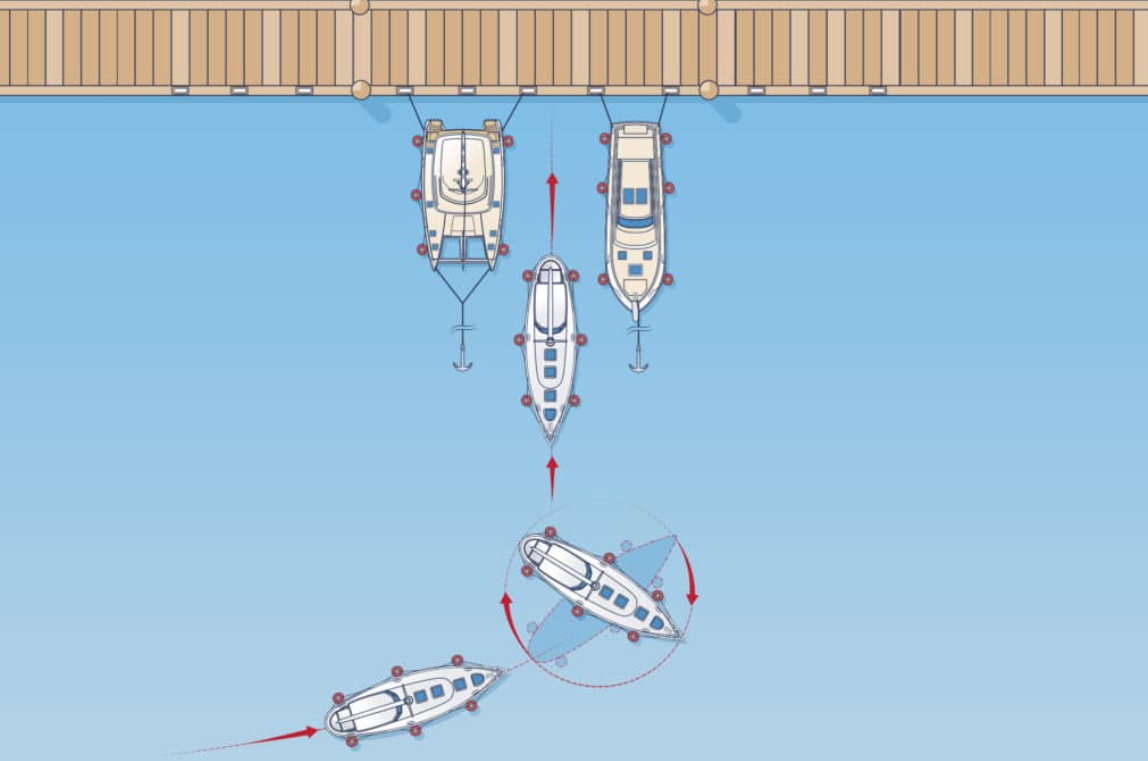
In the Med, it is MUCH MUCH more tricky! Basically we will have to Med-moor. Europeans LOVE this. Americans HATE it (since we never get any practice at it on this side of the Atlantic since it’s more or less insane). The basic point of Med-mooring is for marina operators to jam in 30 boats into a space that can comfortably accommodate 20. The way it works is that we will be backing up to a CONCRETE! pier with other vessels (often mega-yatchs owned by Russian oligarchs with armed security thugs) inches away (or less) on each side. We’ll have tons of pretentious Euros watching us, and judging us, and yelling unsolicited instructions to us in unrecognized languages. We’ll have to somehow tie up to the concrete pier (to a couple of rusty old cringles helpfully located three feet below the edge of the pier just out of reaching distance while you are lying on your tummy in the mud) and then pick up two aptly-named “slime-lines” and drag them forward with their slimy attached mooring lines that are covered in skank up to the bow. (And that’s if we’re lucky! Sometimes we’ll have to play out our anchor while backing into the wall.) We’ll then have to power back and forth as we tie and retie all the lines until we’re snug and can get the passerelle (aka “gangplank” in landlubberspeak) set out without falling in. We’ve got to do all this without destroying the stern of the boat on the concrete, or punching a hole through our new neighbor’s freshly painted and buffed fiberglass, all in a 30 knot cross-wind.
But it’s all fun, and we can be the judgy ones hurling insults when the next boat lines up to squeeze in!
(Okay, it’s probably not as horrible as I am making it sound…but it is a little stressful! A cocktail will be well-deserved!)
Expenses
For general planning purposes, here is a list of typical expenses all in USD. Many of these expenses depend on the sailing destination and the number of people we have on the boat. We’ll assume 3 couples on the boat for this analysis.
Charter Expense
Cabin Fee—$2000 per double cabin per week
Shared Expenses
Provisions—About $1000 for the boat per week (so about $333 per couple per week). This charge is highly variable based on the sailing destination and the dining preferences of the crew (i.e. cooking on-board vs. eating out at restaurants).
Docking/Mooring fees—ranges from about $35 to $300 for the boat per night (depending on the sailing destination and the type of mooring). The Mediterranean is MUCH more expensive than the Caribbean. In the BVI, we can expect about $55 for the boat per night, so about $130 per couple per week.
Fuel—full tanks of fuel are included in most destinations we sail (which is generally more than enough for a week-long charter), except in the Mediterranean. In the Med, we have to purchase full tanks of fuel in advance (about $1400 for the boat for a week). So about $470 per couple per week.
Boat Insurance—somewhat variable based on sailing destination and size of boat. About $875 for the boat for a week, so about $290 per couple per week.
Local Taxes, Permits, and Fees—highly variable. Expect about $50 per couple per week.
Ice, trash removal—typically paid in cash to small boats that approach us at moorings. Highly variable. Expect about $60 for the boat per week, so about $20 per couple per week.
Optional
Boat Toys (kayaks and paddleboards)—available, but expensive to rent. About $200 per kayak or paddleboard for the week.
Dining Out
Depending on crew preference, we may eat many dinners at restaurants along the way. We typically just split these expenses evenly among the diners.
Tracking Expenses
We’re all here to have fun! So we want to keep expense tracking as simple and easy as possible. Our typical approach is this. We put a large EXPENSE envelope containing a pad of paper and a pen in the navigation station (which is like the main desk of the ship). Whenever you purchase something for the boat or pay for dinner for the group, for example, just take the receipt (PLEASE write your name on it!) or write yourself a little receipt (…something simple like “4/18 Tim Ice $10”) and put it in the envelope. After we get home, we’ll add up all of the expenses from the envelope and divide them equally among the group for a final reconciliation. (Double bonus points…if we’re in a country where we are paying for some things in local currency AND paying for other things in US dollars, PLEASE indicate what currency your expense is in!)
Sometimes, at dinners, one couple might be systemically drinking or eating a little less than other couples, in which case, we may all agree to give that couple a credit (maybe twenty-thirty bucks per meal or something that seems about right).
If anyone in the group wants to track shared expenses in much more detail than this (down to the individual appetizer, for example)…you are welcome to do so! We’ll nominate you to be the official quartermaster for the trip and give you the keys to the expense envelope and all of the awesome power that comes with that!