What’s It Like Sailing with Us?
Come Aboard!
We’re here to have fun and we REALLY hope you’ll have fun too!
A Typical Day
A typical day for us usually starts the night before when we gather to have a crew meeting after dinner. (It’s VERY casual, usually with a beer, wine, or cocktail in hand.) If anybody has some good pictures from the day, we’ll probably cast them up onto the TV. And then we’ll chat about what we want to do the next day and when we want to get going. We’ll generally pull up the weather and a chart and pick a destination or two (maybe a town if folks want to go shopping or eating out, maybe a beautiful beach on an uninhabited island, maybe a national park with great snorkeling, or maybe some other famous nearby landmark). We’ll figure out how much sailing (or in some cases, depending on the wind and weather, how much motoring) it will take. Then we may head upstairs to watch the stars from the sun lounge, or play a rousing board game or trivia game, or play some music, and at some point head off to bed. (If we are moored or anchored, anyone and everyone who has an anchor alarm app on their phone can set it, just in case we might start to drag in the night (redundancy is good!)…it’ll give us some warning to make sure we are secured and start the engines if we need to.)
(Note, we won’t be sailing at night. And the amount of sailing we do on many days may be less than you would expect…maybe just 1-4 hours or so, depending on how much folks want to sail and where folks want to go. If we find an exceptionally cool place, and folks want to spend a full day there relaxing, we might not even sail at all…if that is the consensus of the group.)
Your skipper is often the first up in the morning and will likely get the first pot of coffee going. Most often, we eat breakfast on board…cooking up whatever folks have previously discussed as their preference for breakfasts…on some trips that has meant full cooked breakfasts (like pancakes, eggs, omelets, scrambles, etc…) or on other trips lighter fare (like fresh fruit, yogurt, cereal, pastries we picked up at a place the day before, etc…). Occasionally, we may be parked at a dock in a little town or village, in which case, some folks might want to walk over to a cafe or little restaurant for breakfast…totally up to you.
Once folks are done eating, we can either stay for a little bit so folks can swim, snorkel, etc… or go for a drive on the dingy (or maybe paddleboard or kayak, if we have previously rented that equipment), or we can get going to the next destination. (Anyone who wants to sleep in while we are underway is certainly welcomed to do so.)
Just before we leave, the skipper and any interested crew will do a complete walk-around inspection of the ship looking for any open hatches, unsecured items, etc… And we’ll also check to make sure that the swim ladder is up, the dinghy is up and secure, the safety lines are all clipped shut, etc… Then we’ll fire up the engines and cast off. We’ll typically head out to an open area, point the boat into the wind, and then raise the mainsail (which is best done with two people working together). We’ll then get on course and deploy the genoa (the big sail out in front), kill the engines and sail away.
All crew are, of course, welcomed to take the helm, plot the course, participate in trimming (i.e. adjusting) the sails, etc… In terms of navigation, the ship has the latest equipment which includes a chart-plotter (basically, an advanced GPS system for maritime vessels), AIS (Automatic Identification System, which is integrated into the chart-plotter and is a sophisticated anti-collision system that calculates the time to and closet point of approximation to any other AIS-equipped vessel), wind instruments (also integrated into the chart-plotter), auto-pilot (integrated into the chart-plotter), depth indicator, VHF, forward facing camera, etc… (It all sounds trickier than it actually is.) Even if you are new to sailing, if you are interested, you’ll likely be in command of the vessel, to the extent that you are comfortable, within a day or two. The skipper will always be nearby to help. You’ll have as much time at the helm as you want.
Amazingly, not everyone will want to sail the boat! (Hard to believe, I know!) If you prefer, you can spend some or all of the day’s sailing up on the foredeck (which is a great place to feel the wind, hang out on a beanbag chair usually chatting with others, watch for dolphins, etc…). Or you can hang out in the sun-protected aft cockpit reading a book. Some may prefer to hang out in the sun-lounge up top…it gets pretty sunny up there watching the islands drift by!
We’ll then “park” the boat at our destination….more about parking later. Once the boat is secure, the pool is open and you are welcome to drop the swim ladder and jump in for a snorkel or swim. Some or all of us may then head to shore in the dinghy to explore a town, or a beach, or resort, or a winery, or some other landmark.
By a least an hour or so before sunset, we’ll probably all be back on the boat to shower and change and freshen up for dinner. We’ll probably have some hors d’oeuvres and maybe a glass of wine or something. Depending on crew preference, we may then dinghy over to a nearby restaurant (which seems to be the primary preference for most of our crews we’ve had). Or, if folks are interested (or if we’re in a remote area far off the grid), we might cook dinner on board. If there are lobster to be had, we might grill some up on the BBQ. (We’ll discuss food preferences with the crew long before we start the trip and have a general dinner plan for most nights.) If we are returning from a restaurant at night, we’ll be sure to bring some flashlights in the dingy to help navigate back to the boat.
After dinner, we’ll decompress a bit. Have a quick crew meeting to discuss plans for the next day…and REPEAT!
Parking the Boat
There are generally three options for how we secure the boat each night: picking up a mooring ball, anchoring, or tying up on a dock.
Picking up a Mooring Ball
Picking up a mooring ball is what we do most often because: it’s pretty easy; it’s generally pretty secure; it’s not too expensive; and it usually gives us very good dinghy access to locations on land that we want to visit. There are two kinds of “flavors” to mooring balls…self-serve and assisted.
In the BVIs, they have a fantastic self-service system (and app) called “Boaty Ball”. Most of the mooring balls in the country are on this system. Boaty Ball balls are generally well-inspected and well-maintained and you can reserve balls in advance starting at 7 am each morning on the app. (Your skipper will likely be waking up each morning at 6:57 am to logon and make sure we get a good ball exactly at 7 am….popular mooring fields in high-season in the BVIs can sell out in seconds!) There are also non-reservable balls called FCFS (First Come First Served) that we can grab in person starting at noon local time. Either way, once we get to a mooring field, we’ll find our ball, then we will line up the boat (while motoring) so that we are approaching it from down-wind. As we get close to the ball, the skipper won’t be able to see it, so we will be dependent on the crew with a headset walkie-talkie to guide him in. (Your Skipper and Admiral generally travel with walkie-talkie headsets for this exact purpose. We’ll have some back up hand signals figured out, just in case.) In the BVIs, each ball will have a long floating line (called a “pendant”) attached to it with a ring at the end. We’ll need to pick up the pendant with a boathook from the bow of the boat, then run two prepared mooring lines through the ring, then secure those lines to our bow cleats. It can be a little tricky, especially if it is windy and the boat is being blown around. But we’ll get it. We do have to be very careful that the mooring lines run from the cleat, directly out to the ball and back to the cleat, without crossing on top of the ship’s safety lines or other gear on the front of the boat…the mooring lines can destroy equipment on the front of the boat if incorrectly tied! FCFS balls are usually $40 per night and reservable Boaty Balls are $55 per night.
Assisted balls are a little more of a pain. (You find these in the Med and southern Caribbean.) Basically, the balls don’t have a pendant, so you are more or less reliant on someone in a small boat (usually the owner of the ball, but sometimes just a rando looking for a tip) to come up and park their little boat next to the ball. Once we are close, the crew lowers our mooring lines down to the guy (while the skipper tries not to run him over), the guy in the boat threads the lines through a ring on top of the ball, and then hands the lines back up to the crew on the bow. The crew then ties the lines off on the bow cleat…and the guy then collects a fee or a tip. In the Med, we’ll call ball owners on VHF in advance to find out if they have a ball available and what the price is, and then they will send a boat once we call them to let them know we have arrived. In the Southern Caribbean, randos will just come out to our boat whenever we get anywhere near a mooring field and show us where they think we should go. It is impossible to be sure what the relationship between the rando and the ball owner is…and there may be multiple randos fighting with each other to get us to follow them, and a lot of dickering and nonsense about the price of ball, how much tip they should get, etc… (Balls in the BVIs are SO MUCH EASIER!) Occasionally, we’ll find a ball with no randos around. In which case, we’ll have to launch the dinghy, have someone in our crew drive around to the ball, catch the lines, thread the ring, and hand up the lines. It’s a big pain! Balls in the Med can be pretty expensive, up to 80-100 Euros per night. Balls in the southern Caribbean are more like US $30-40 per night plus the tip for the rando. Even if we have to tie up ourselves, someone for sure will come around later to collect a fee. (Always try to get them to give you a receipt. Not all of the guys collecting fees are the legit ball owners or their representatives! If the guy doesn’t have a receipt to give, he might be a real rando rando (i.e. scam artist), just trying to get some free money.)
Once we’re securely on the ball, someone from the crew (usually the skipper) will have to put on some fins, jump in, and swim the line (inspecting the line that connects the ball to the sea floor and assuring that it’s in good shape). There are a ton of idiots out there…and some of them may have chewed up the line with their propellers. We don’t want to be connected to a ball that is hanging on by a thread! (We had a mooring ball break off on us for that exact reason….we were super lucky because the ball broke off almost immediately, before we had even shut down our engines. Many other sailors are not so fortunate…a poorly maintained ball is a great way to end up on the rocks!)
(Boaty Ball balls tend to be very good in this regard. The first 15-20 feet of the line are generally made out of thick chain….so the likelihood that it has been chewed up by a prop are very low. Other balls can be a lot more sketchy.)
Anchoring
In principle, this sounds like a great way to go because it’s generally free. In practice, there are fewer and fewer spots to anchor near places where we will want to visit on a vacation (near desirable towns, restaurants, and beaches) because a lot of the best places are today filled with permanent mooring balls. Anchoring also has its own tricks and challenges. Books have been written about anchoring, so we won’t get into all the details here, but in general, we will want to anchor in a sandy spot that is protected from sea swell and waves and is not too deep. (Those criteria right there significantly limit our options.) And we will want to be anchored a good distance from other boats so we don’t swing and hit them in the middle of the night…that REALLY drops the options since any good sandy protected spot will probably already have a ton of boats anchored there. If we do anchor, it’ll likely be at a pretty remote location.
The drill for anchoring sounds pretty simple. We have an electric windlass (that raises and lowers our anchor and anchor chain down to the bottom). Once we get the anchor where we think we want it, we’ll continue to lay out a lot of chain on the sea floor while slowly inching backwards (so that the anchor has a better chance of digging in and setting). How much chain??? Again, books have been written about this…..but in general, more is always better in terms of setting the anchor. The problem is the more anchor chain we put out, the bigger our swing, meaning we could swing into other boats or the shore in the middle of the night when the wind shifts. At some point, we’ll stop laying out chain (your skipper will take his best guess, because the boat doesn’t have a chain counter and the anchor chain is not marked…I’ve never understood why charter companies don’t fix that)! Then we will attach an “anchor bridle” to the chain (two heavy lines that are attached to the bow of each hull and which can clip onto the anchor chain). We’ll then release a little more anchor chain so that the bridle is taking the full load of the boat (releasing pressure on the super expensive windlass). At this point, the skipper will put the boat into reverse and begin to pull back harder and harder on the throttle trying to get the anchor at the other end to really dig in deep and hard. If the boat slips backward, we know that the anchor is not set or set well, so we’ll have to do something….most likely we’ll have to pull forward, disconnect the bridle, raise up the anchor and try again (or, alternatively, put out more chain). Then someone will have to jump in and swim down to take a look to be sure the anchor is set properly. Once we do get everything set and secure just right, inevitably, some other lookie-loo boater passing by will decide…”Hey, that guy just anchored there….must be a GREAT spot!” So that skipper will show up and try to drop his anchor 5 feet from us. There will be swearing (usually in a lot of languages), rude gestures, yelling, more swearing, etc… Lots of relaxing fun! Suffice it to say, given the option of: A) paying 50 bucks for a ball in a nice, protected location close to a picturesque town, VERSUS: B) fighting it out with locals for a tiny patch of sand 5 miles from the nearest restaurant…I’m probably going “A”.
Docking
Docking is the most expensive option and has its own additional advantages and disadvantages. In high season in the Med, a docking fee may run up to 200-300 Euros per night! In the BVIs it’s more like US$150. For these fees you will often get shore power and water hook-ups, but not always.
The big advantage is proximity. Especially in little islands in the Med, the town center (and the best restaurants, bars, shops, etc…) tend to surround the harbor. So, if we can get a spot on the main quay, we’re often just a few feet from fantastic seaside restaurants and nightlife….we often have the best real estate in town! And in the BVIs, the nicest boutique resorts have their own private marinas. If we spend the night, we can eat at their restaurants, and often, for a fee, use their pools, spas and amenities. And it is easy for everyone to come and go when they want. No need to use the dinghy (which makes me sad, ‘cause I love the dinghy…but not everyone loves it as much)!
With the docking option, there are again two flavors: regular old docking and the dreaded “Med-mooring”…which all American skippers hate.
For regular old docking (in the BVIs, US, and Caribbean in general), we’ll just call ahead to the marina on VHF, get instructions about where they want us to go, and do what they tell us to do. We’ll often be backing into a slip (where we will basically have dockage on three sides: port, starboard and aft. We’ll need to prepare some docking lines and get the fenders hung up around the boat ahead of time. We’ll often need to take down the dinghy and tie it off to a cleat at the bow, so it doesn’t interfere when we back in. It’s all a little tricky, but do-able. Usually there will be at least one dude on the dock to help…often they’ll send out a guy in a boat who can help as well. In the BVIs there are only a few marinas we will possibly be dealing with: our home port in Road Town, the new marina on Peter Island, the marina on Scrub Island, and the new marina at Oil Nut Bay. (All four of these are top notch facilities.) There is also a small more industrial marina at Spanish Town on Virgin Gorda. The Moorings marina at Road Town will actually send out a skipper, if we want, to park the boat for us! (They don’t want some idiot noob to crash into a row of their multi-million dollar boats.)
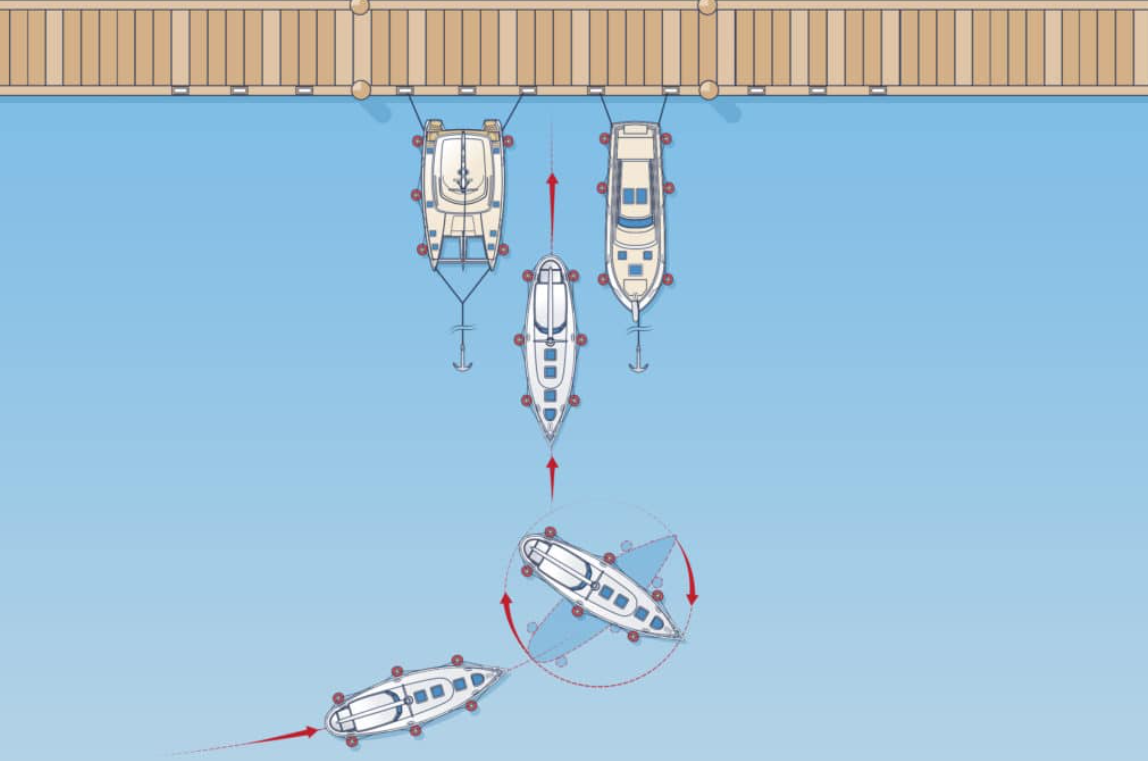
In the Med, it is MUCH MUCH more tricky! Basically we will have to Med-moor. Europeans LOVE this. Americans HATE it (since we never get any practice at it on this side of the Atlantic and it’s just more or less insane). The basic point of Med-mooring is for marina operators to jam in 30 boats into a space that can comfortably accommodate 20. The way it works is that we will be backing up to a CONCRETE! pier with other vessels (often mega-yatchs owned by Russian oligarchs) inches away on each side. We’ll have tons of pretentious Euros watching us, and judging us, and yelling solicited instructions to us in unrecognized languages. We’ll have to somehow tie up to the concrete pier (to a couple of rusty old cringles helpfully located three feet below the edge of the pier just out of reaching distance while you are lying on your tummy) and then pick up two aptly-named “slime-lines” and drag them forward with their slimy attached mooring lines that are covered in skank up to the bow. We’ll then have to power forward and back as we tie and retie all the lines until we’re snug and can get the passerelle (aka gangplank) set out without falling in. We’ve got to do all this without destroying the stern of the boat on the concrete, or punching a hole through our new neighbor’s fiberglass, all in a 30 knot cross-wind.
But it’s all fun, and we can be the judgy ones when the next boat lines up to squeeze in!